
Anatomy
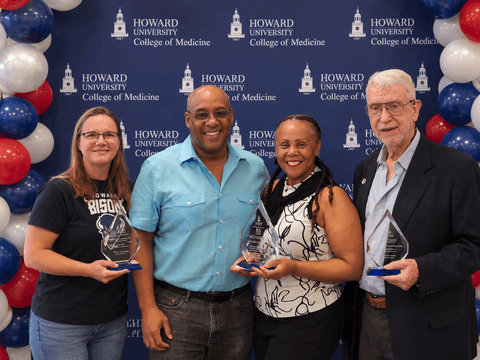
The Howard University Department of Anatomy recently celebrated three remarkable members of the Howard community whose contributions collectively represent 102 years of service to Howard University.
Pictured from left to right are Dr. Janine Ziermann-Canabarro, who, after 14 years of service, is embarking on the next chapter of her career; Dr. Byron Ford, Chair of the Department of Anatomy; Ms. Lynette Thompson, who is retiring after an extraordinary 45 years of service; and Dr. Raymond Bernor, who retired after 43 years of service and continues to contribute to Howard’s educational mission by teaching in the College of Dentistry.
Reflecting on their contributions, Dr. Ford stated, “As we celebrate Ms. Thompson and Dr. Bernor in retirement and wish Dr. Ziermann-Canabarro continued success in the next chapter of her career, we are deeply grateful for the countless lives they have touched through their teaching, mentorship, service, and commitment to Howard.”
The Department of Anatomy proudly celebrates their collective legacy and thanks them for their extraordinary dedication to Howard University and generations of medical, dental, and allied health students.
Welcome from the Chair
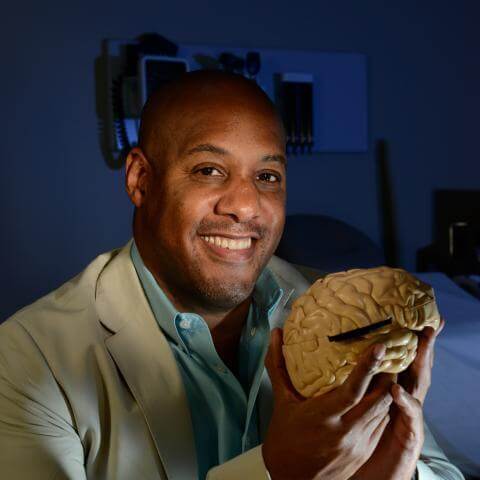
Welcome to the Department of Anatomy at the Howard University College of Medicine.
It is my pleasure to welcome you to one of the foundational departments of our College of Medicine. The Department of Anatomy is dedicated to excellence in education, research, and service while preparing the next generation of healthcare professionals and biomedical scientists.
Our faculty provide outstanding instruction in anatomy and gross anatomy to students across the College of Medicine, College of Dentistry, College of Nursing and Allied Health Sciences, and the Interdisciplinary Biomedical Sciences (IBMS) Program. Through innovative teaching methods, state-of-the-art learning experiences, and a commitment to academic excellence, we equip our students with the essential anatomical knowledge that serves as the cornerstone of clinical practice and biomedical discovery.
Beyond the classroom, the Department of Anatomy fosters a vibrant research environment that offers opportunities for undergraduate, graduate, and medical students to engage in cutting-edge investigations in anatomy, neuroscience, and the rapidly evolving fields of artificial intelligence and machine learning (AI/ML). Our research programs encourage collaboration, innovation, and scientific inquiry, empowering students to contribute to advances that improve human health.
Whether you are a prospective student, current learner, researcher, alumnus, or visitor, I invite you to explore all that the Department of Anatomy has to offer. Together, we continue Howard University's proud legacy of excellence while shaping the future of biomedical education and research.
We look forward to welcoming you to our department.
Byron Ford, Ph.D.
Chair, Department of Anatomy
Howard University College of Medicine
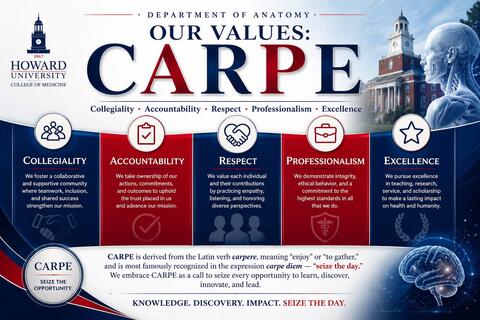
We are guided by the core values of Collegiality, Accountability, Respect, Professionalism, and Excellence (CARPE). These principles define how we teach, conduct research, collaborate, and serve our students, colleagues, and communities. CARPE is derived from the Latin verb carpere, meaning "to enjoy" or "to gather," and is most famously recognized in the expression carpe diem, "seize the day." Inspired by this timeless phrase, our department embraces CARPE as a call to seize every opportunity to learn, discover, innovate, and lead. By fostering a culture of collegiality, holding ourselves accountable, treating others with respect, demonstrating the highest standards of professionalism, and pursuing excellence in all that we do.
| Authors | Title | Journal/doi | Year |
|---|---|---|---|
| Christopher McGinley, Oyinkansola Adeyemi, Oluwafayokemi Oyolola, Byron D Ford, Gregory D Ford | Redox State of Glutathione and Cysteine in Plasma Following Acute Stroke. https://pubmed.ncbi.nlm.nih.gov/41596175/ | Antioxidants / doi: 10.3390/antiox15010117. | 2026 |
| Jessica M Noll, Christopher McGinley, Catherine J Augello, Esra Kürüm, Liuliu Pan, Anna Pavenko, Andy Nam, Byron D Ford, Gregory D Ford | Neuregulin-1 promotes early regenerative and autophagic responses after ischemic stroke via spatial proteomics. https://pubmed.ncbi.nlm.nih.gov/42311785/ | Front Cell Neurosci. doi: 10.3389/fncel.2026.1739619. | 2026 |
| Janine M Ziermann-Canabarro, Julia C Boughner, Kristen N McPike | Role of p53 family members during development of striated muscle, with focus on p63. https://pubmed.ncbi.nlm.nih.gov/40937686/ | Dev Dyn. doi: 10.1002/dvdy.70077. | 2026 |
| Christopher N Cross, Alessandro Lisi, Faith C Simmonds, Marisol Fermin Flores, Kareem Washington, Thomas Heinbockel, Michael C Campbell | The evolutionary landscape of host immunity genes involved in respiratory and other immune-related diseases, and the identification of TLR2 variation associated with severe COVID-19. https://pubmed.ncbi.nlm.nih.gov/42215996/ | BMC Biol. doi: 10.1186/s12915-026-02623-6. | 2026 |
| Csoka AB, Stambler I, West MD, Heinbockel T, Bhowmik D, Herbig U, Stair SE | Aging as meta-disease: a comprehensive framework integrating set theory with cellular senescence as causal nexus. https://link.springer.com/book/10.1007/978-3-032-20006-8 | Stambler I (ed) Healthy Longevity: Policies and Practices. doi.org/10.1007/978-3-032-20006-8 | 2026 |
| Heinbockel T, Brown E | Multiple roles of cannabinoids in the olfactory system. https://www.mdpi.com/2076-3425/16/2/190 | Brain Sci. doi.org/10.3390/brainsci16020190 | 2026 |
| Kimberly R Bennett, Monique C Surles-Zeigler, Catherine J Augello, Etchi Ako, Hakeem Omotayo, Gregory D Ford, Victor G J Rodgers, Byron D Ford | Transcriptomic identification of CREB1 and FOXO1 activation in neuregulin-1-mediated neuroprotection after stroke | Front Mol Neurosci. doi: 10.3389/fnmol.2026.1741120. | 2026 |
| Araj Shah, Saujanya Thapaliya1, Vijay Chaudhary, Fadel Lashhab , and Kholood Ahmad | An Open and Verifiable ConvNeXt-Based Pipeline for Breast Cancer Detection in Mammography Using CBIS-DDSM | Researchgate.net |