
HUCM - Office of Research
Research and discovery are central to the mission of the Howard University College of Medicine. As part of Howard University, recently designated a Research One (R1) institution by the Carnegie Classification, the College of Medicine Office of Research, established in 1971, is building upon a longstanding legacy of biomedical discovery to address some of the most pressing challenges in human health. Our investigators advance research across cancer, cardiovascular disease, neuroscience, genomics and precision health, infectious disease, molecular and cellular biology, and other areas with particular relevance to populations that have historically experienced disparities in health and healthcare.
The Office of Research supports this mission by fostering scientific discovery, interdisciplinary collaboration, research training, innovation, and the translation of discoveries from the laboratory to the clinic and community. Through resources such as the RCMI research infrastructure and core laboratories, the Georgetown-Howard Universities Center for Clinical and Translational Science, the Howard University Cancer Center, the Center for Sickle Cell Disease, and emerging initiatives in artificial intelligence, computational medicine, and precision health, the College is expanding its capacity to generate discoveries that improve human health. We are committed not only to advancing biomedical science, but also to preparing the next generation of physicians, scientists, and physician-scientists to lead the future of medicine.
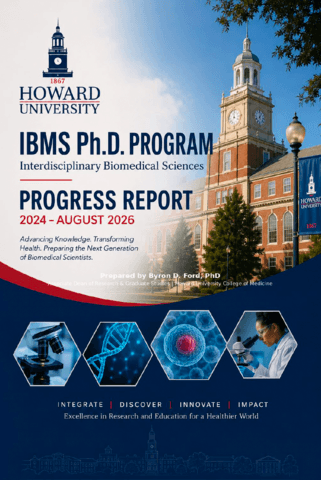
The Office of Research is equally committed to cultivating the next generation of physicians, scientists, and physician-scientists by creating a continuum of research training across the College of Medicine. Through the Medical Student Research Program (MSRP), medical students are connected with faculty mentors and provided opportunities to engage in basic, clinical, translational, and collaborative research throughout their medical education. These experiences promote scientific inquiry, critical thinking, scholarly publication, and the development of skills essential for evidence-based medicine and careers in academic medicine and biomedical research. The Office also supports graduate research and training through the newly established Interdisciplinary Biomedical Sciences (IBMS) Graduate Program, which provides rigorous, cross-disciplinary training leading to the Ph.D. in Biomedical Sciences and the dual M.D./Ph.D. degree. Through laboratory rotations, faculty mentorship, interdisciplinary coursework, specialized and individualized research tracks, and dissertation research, IBMS prepares graduate students and physician-scientists to become independent investigators capable of translating fundamental discoveries into advances in human health. Together, MSRP and IBMS establish an integrated research-training pipeline that extends from medical student scholarship through doctoral and physician-scientist training and strengthens the College of Medicine's contribution to Howard University's growing R1 research enterprise.
Contacts
Byron D. Ford, PhD John T. Stubbs III, Ph.D.
Associate Dean for Research and Graduate Studies. Director, Medical Student Research
College of Medicine College of Medicine
520 W Street NW, Numa Adams 1105 520 W Street NW Suite 530
Washington, DC 20059 Washington, DC 20059
byron.ford@howard.edu. jstubbs@howard.edu